Showing posts with label George W. Bush. Show all posts

Tuesday, March 4, 2008

BUSH OKAY'S MORE, EASIER MONEY FOR P.A.

Bush waives direct transfer ban for P.A. (JTA)
President Bush waived congressional restrictions to directly transfer $150 million to the Palestinian Authority.

The transfer ordered Friday is part of a package of more than $500 million in Palestinian assistance earmarked for use this year. Most of the money is project based and to be funneled through the U.S. Agency for International Development, the U.N. Relief and Works Agency and nongovernmental organizations.

Such transfers are subject to relatively light congressional oversight. However, Congress in recent years has banned direct transfers of cash because of fears that the money could end up in terrorist hands and because of concerns about P.A. corruption. Much of the pro-Israel community also strongly opposes direct transfers.

The Bush administration says the Palestinian Authority needs the cash to leverage loans at a time that it is confronting extremists and pursuing peace talks with Israel.

A U.S. official told the JTA that the assistance was "critical" and added that it will "help avert a serious and immediate financial crisis for the P.A., ensure its continued operation, and further the United States’ longstanding and bipartisan goal of a just and lasting peace between Israel and the Palestinians."

WHITE HOUSE BLAMES HAMAS FOR LATEST GAZA FIGHTING

White House Faults Hamas in Gaza Violence - Jennifer Loven
The White House on Monday blamed the Palestinian militant group Hamas for causing the fighting between Israelis and Palestinians that has killed dozens and put a halt to peace talks. Gordon Johndroe, a spokesman for President Bush's National Security Council, said: "The No. 1 thing that has to happen is that Hamas has got to stop targeting Israeli citizens with rockets. It must stop." (
AP)

Thursday, February 14, 2008

BUSH SIGNS WAIVER ALLOWING PLO TO STAY IN D.C.; U.S. EMBASSY IN TEL AVIV

Bush Signs Waiver Allowing PLO to Remain in Washington (INN)
US President George W. Bush has signed another 6-month waiver allowing the PLO to remain in Washington and the US Embassy remains in Tel Aviv.

Monday, February 11, 2008

BUSH'S MIDEAST U-TURN

Bush's Mideast U-Turn By BASSEM EID AND NATAN SHARANSKY (WSJ)
On June 24, 2002, President Bush presented his vision for an Israeli-Palestinian peace.... 


The real breakthrough of Mr. Bush's vision five-and-a-half years ago was not his call for a two-state solution or even the call for Palestinians to "choose leaders not compromised by terror." Rather, the breakthrough was in making peace conditional on a fundamental transformation of Palestinian society: "I call upon [Palestinians] to build a practicing democracy, based on tolerance and liberty. If the Palestinian people actively pursue these goals, America and the world will actively support their efforts. . . . A Palestinian state will never be created by terror -- it will be built through reform. And reform must be more than cosmetic change, or veiled attempt to preserve the status quo. True reform will require entirely new political and economic institutions, based on democracy, market economics and action against terrorism."

Many critics argued at the time that linking the peace process to a transformation of Palestinian society was a radical departure in peacemaking. It was. And it was long overdue.

What had guided policymakers for the previous decade was the idea that a "moderate" Palestinian leader who would fight terror and make peace with Israel needed to be "strengthened" at all costs. Yasser Arafat was their moderate. He was given territory, weapons, money and a warm diplomatic embrace.

Completely ignored was what was happening within Palestinian society. As Arafat was hollowing out civil society, handing control of the economy to corrupt cronies, squirreling away billions of dollars into his private accounts, trampling on the rights of his own people, and using PA-controlled media and schools to indoctrinate a generation into a culture of hatred, the international community's bear hug only tightened. Indeed, Arafat's emerging dictatorship was seen as an asset in the peace process. Here was the "strong" leader, it was argued, who could make a deal. Nothing should be done to weaken him.

Mr. Bush's speech was supposed to change all this. It was supposed to shift the focus to where it should have always been: on helping Palestinians build a decent society that would protect the rights of their own people and promote peace with its neighbors. It was supposed to begin the hard work of helping Palestinians reconstruct their civil society, build a free economy, establish real courts, reform their security services, and revamp their educational system.

President Bush deserves much credit for placing a spotlight on the issues of democracy and human rights and for his firm belief that the advance of freedom is critical for international peace and stability. He made this idea a focus of his second inaugural address and reiterated it last June in Prague at a conference of dissidents from around the world. Last month, President Bush did not flinch from speaking about freedom and human rights in the heart of Arabia.

But the past few years have shown that when it comes to dealing with Israelis and Palestinians, the vital link between freedom and peace is almost entirely ignored. True, the administration is not doing anything against the wishes of the current Israeli and Palestinian leadership. But just as the Oslo peace process of the 1990s was a disaster that Israeli and Palestinian leaders wholeheartedly embraced, the current peacemaking round will prove equally disastrous because it ignores what is most important.

Rather than begin the long and difficult process to transform Palestinian society and ultimately pave the road to peace, the administration has consistently supported quick and foolish solutions: from crafting a "road map" that only paid lip service to reform; to backing a unilateral disengagement that by its nature ignored Palestinian society; to pressing for snap elections that preceded rather than followed reform and thereby brought Hamas to power.

Thursday, January 17, 2008

BUSH'S CHANGE OF COURSE A FAILURE

Bush's Middle East Hopes By Daniel Pipes

George W. Bush's policies toward the Middle East and Islam will loom large when historians judge his presidency. On the occasion of his concluding his 8-day, 6-country trip to the Middle East and entering his final year in office, I offer some provisional assessments.

His hallmark has been a readiness to break with long-established bipartisan positions and adopt stunningly new policies, and by late 2005 he had laid out his novel approach in four major areas.

  • Radical Islam: Prior to 9/11, American authorities viewed Islamist violence as a narrow criminal problem. Calling for a "war against terror" in September 2001, Bush broadened the conflict. Specifying the precise force behind terrorism peaked in October 2005, when he termed it "Islamic radicalism," "militant Jihadism," and "Islamo-fascism."

  • Pre-emptive war: Deterrence had long been the policy of choice against the Soviet Union and other threats, but Bush added a second policy in June 2002, pre-emption. U.S. security, he said, "will require all Americans to be forward-looking and resolute, to be ready for preemptive action when necessary to defend our liberty and to defend our lives." Nine months later, this new doctrine served as his basis to invade Iraq and eliminate Saddam Hussein before the latter could develop nuclear weapons.

  • Arab-Israeli conflict: Bush avoided the old-style and counterproductive "peace process" diplomacy and tried a new approach in June 2003 by establishing the goal of "two states, Israel and Palestine, living side by side, in peace and security." In addition, he outlined his final-status vision, specified a timetable, and even attempted to sideline a recalcitrant leader (Yasir Arafat) or prop up a forthcoming one (Ehud Olmert).

  • Democracy: Deriding "Sixty years of Western nations excusing and accommodating the lack of freedom in the Middle East" as a policy that "did nothing to make us safe," Bush announced in November 2003"a forward strategy of freedom in the Middle East," by which he meant pushing regimes to open up to citizen participation.

So much for vision; how about implementation? At the end of his first term, I found that the Bush policies, other than the Arab-Israeli one, stood "a good chance of working." No longer. Today, I perceive failure in all four areas.

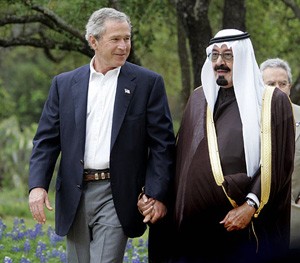
George W. Bush and Abdullah of Saudi Arabia, hand in hand.

Bush's once-improved understanding of radical Islam has been reversed, to the point that he uses lengthy and inelegant euphemisms to avoid referring to the problem by name, relying on formulations like "a group of extremists who seek to use religion as a path to power and a means of domination."

Pre-emptive war requires convincing observers that the pre-emption was indeed justified, something the Bush administration failed to do. Only half the American population and many fewer in the Middle East accept the need for invading Iraq, creating domestic divisions and external hostility greater than at any time since the Vietnam War. Among the costs: greater difficulty to take pre-emptive action against the Iranian nuclear program.

Bush's vision of resolving one century of Arab-Israeli conflict by anointing Mahmoud Abbas as leader of a Palestinian state is illusory. A sovereign "Palestine" alongside Israel would drain the anti-Zionist hatred and close down the irredentist war against Israel? No, the mischievous goal of creating "Palestine" will inspire more fervor to eliminate the Jewish state, especially if accompanied by a Palestinian "right of return."

Finally, encouraging democracy is clearly a worthy goal, but when the Middle East's dominant popular force is totalitarian Islam, is it such a great idea to rush head-long ahead? Yet rushing ahead characterized Washington'sinitial approach – until the policy's damage to U.S. interests became too apparent to ignore, causing it largely to be abandoned.

At a time when George W. Bush arouses such intense vituperation among his critics, someone who wishes him well, like myself, criticizes reluctantly. But criticize one must; to pretend all is well, or to remain loyal to the person despite his record, does no one a favor. A frank recognition of shortcomings must precede their repair.

I respect Bush's benign motivation and good intentions while mourning his having squandered a record-breaking 90 percent job-approval rating following 9/11 and his bequeathing to the next president a polarized electorate, amilitary reluctant to use force against Iran, Hamas ruling Gaza, an Iraqi disaster-in-waiting, radical Islam on theascendant, and unprecedented levels of global anti-Americanism.

Conservatives have much work ahead to reconstruct their Middle East policy.

Wednesday, January 16, 2008

U.S. BACKTRACKS ON COMMITMENTS TO SHARON RE "SETTLEMENTS"

Diplomat: Israel and U.S. Differ on Interpretation of Bush's 2004 Letter to Sharon - Barak Ravid and Nadav Shragai (Ha'aretz)

The U.S. clarified to Israel during President Bush's visit that it disapproves of all Israeli building in eastern Jerusalem and the West Bank - including in the large settlement blocs, a senior Western diplomat said Tuesday. He added that Israel and the U.S. differ on their interpretation of the letter President Bush sent to former prime minister Ariel Sharon in April 2004.  "The letter refers to major population centers and not the settlement blocs, while stressing that everything must also be decided in the negotiations between the Israelis and the Palestinians," the diplomat said.

Monday, January 14, 2008

BUSH THROWS ISRAEL UNDER THE BUS

Peace In Our Time (Spectator UK)

Rarely has a moral compass been so completely and publicly destroyed by its owner. George W Bush’s presidency has been defined by the moral position he took, under the impetus of 9/11, to repudiate the amoral realpolitik of his predecessors in appeasing and rewarding aggression while ignoring or even punishing its victims. Instead he would hold the aggressor’s feet to the fire and support and promote those who stood for freedom and democracy. Controversial as this doctrine undoubtedly was in the eyes of many in the US and around the world, it was at least consistent — with one niggling exception. On the Israel Arab impasse, Bush veered between making extraordinarily impressive speeches which correctly identified Arab aggression and incitement to hatred of Israel as the core problem to be addressed, and the imposition of the ‘Road Map’ which, by detailing the steps both Israel and the Palestinians had to take, descended into the kind of moral equivalence — and thus negation of the centrality of Arab aggression — which has kept this conflict alive for the past sixty years. At the time, however, it seemed that the Road Map was no more or less than a sop to Tony Blair — who has always failed grievously to grasp that the Palestinians don’t want a state, they want the Jewish state — as a gesture of thanks for his support over Iraq.

With Bush’s visit to the Middle East this week, however, any such residual excuse is blown away along with the last shreds of his claim to moral integrity. Peace between Israel and the Palestinians, he said blithely, was eminently possible this year. But everything he then said was about pushing Israel to make ‘painful concessions’ rather than the Palestinians. Since the sole obstacle to peace in the Middle East is the Arab rejection of the Jews’ right to their own ancestral home — the fact that Mahmoud Abbas not only has consistently refused to halt the continuing violence against Israel by both Hamas and his own Fatah affiliates, not only has refused to halt the incitement to hatred of Israel perpetrated daily by his own education system and PA controlled media, but has also repeatedly and consistently demanded the right of mass Palestinian immigration to Israel, thus showing his ‘aspiration’ for a Palestinian homeland existing peacefully alongside Israel to be totally bogus as was underlined by his chief negotiator’s recent declaration that the Palestinians would never recognised Israel as a Jewish state — Bush’s position is tantamount to pushing Israel to surrender to an enemy still hell-bent upon Israel’s annihilation.

BUSH TO OLMERT: HIT GAZA BUT NOT CIVILIANS

Bush to Olmert: Hit Gaza Without Hitting Civilians by Gil Ronen
(IsraelNN.com) U.S. President George W. Bush gave Israeli Prime Minister Ehud Olmert a green light to mount a comprehensive ground offensive against the terrorist infrastructure in Gaza, according to the London daily Al-Sharq al-Awsat ("The Middle East") which quoted diplomatic sources in Israel. The sources said that the two leaders discussed the matter during Bush's three-day visit to Israel last week....

President Bush, however, voiced concern that a large-scale military operation would lead to a "humanitarian crisis" in Gaza. The sources said that Bush gave Olmert a green light for a military operation in Gaza, but that he also spelled out certain limitations and demanded that Olmert make sure the operation did not wind up hurting civilians.

BUSH PROMOTES A PALESTINIAN "RIGHT OF RETURN"

Bush Promotes a Palestinian "Right of Return" By Daniel Pipes

The Palestinian "right of return" entered the lexicon of American policymakers in December 2006, when the Iraq Study Group Report urged the U.S. government to support Israel-Palestinian negotiations that addresses what it termed a "key final status issue." That recommendation came as a mild shock, given that the "right of return" to Israel is transparently a code phrase to overwhelm Israel demographically, thereby undoing Zionism and the Jewish state, and so never before a goal of official Washington.

A year later, White House deputy press secretary Dana Perino adopted the term, though without much notice. Out of seemingly nowhere, she informed journalists at a press briefing on November 28, 2007 that "The right of return issue is a part of the road map and it's going to be one of the issues that the Israelis and the Palestinians have to talk about during … negotiations."

Indeed, on schedule, "right of return" emerged as a motif before and during George W. Bush's recent trip to Israel and the Palestinian Authority, when he mentioned it three times publicly:

  • January 4: In an interview with Israel's Channel 2, Bush announced himself "optimistic that we can have the outlines of a state defined. In other words, negotiations on borders and right of return and these different issues can be settled."

  • January 9: At a joint press conference with Israel's Prime Minister Ehud Olmert, he referred to the core issues of the conflict as "territory and right of return and Jerusalem."

  • January 10: In a parallel joint press conference with Palestinian Authority leader Mahmoud Abbas, he stated that the two-state idea "really doesn't have much bearing until borders are defined, right of return issues resolved, Jerusalem is understood, … [and] the common security measures will be in place."

In a different setting, also on January 10, Bush, somewhat elusively, stated his belief that "we need to look to the establishment of a Palestinian state and new international mechanisms, including compensation, to resolve the refugee issue." Is the "right of return" to be one of those new international mechanisms?

Comments: (1) Despite the major shift in policy implied by the U.S. government adopting the "right of return," the media has largely missed the story, as "The Lurker" documents in "Censoring Bush's call for Palestinian ‘right of return'." In particular, the Jerusalem Post reported on this reference, then posted a second story denying it.

(2) When the Iraq Study Group Report first appeared, analysts puzzled over the "right of return" mention, as one person close to the process explained: "It's hard to know whether that language got in there because of carelessness – I know there were many revisions up to the very last minute – or whether it was a deliberate attempt to fuse something to the Bush rhetoric which wasn't there before." Retrospectively, it appears that the reference was indeed intentional – and quite successful in its purpose. "The Lurker" concludes, perhaps correctly, that James A. Baker, III, lead author of the Iraq Study Group Report, "has once again become a major factor in setting U.S. Middle East policy."

(3) This is only one of several problematic statements from the Bush administration, such as the president's morally equivalent reference to "terrorism and incitement, whether committed by Palestinians or Israelis" or Secretary of State Condoleezza Rice's calling the Arab-Israeli conflict the central issue of the Middle East and seeing Palestinians as analogous to Southern blacks.

(4) Bush prefaced his January 10 comment by asserting, "I'm the only president that's really articulated a two-state solution so far," and he is right. Put differently, he is the only U.S. president to promote a "Palestine" and now to call for a Palestinian "right of return." More broadly, throughout his presidency, Bush has marched to his own drummer on the Arab-Israeli issue, offering novel and personal solutions to a century-old problem andthrowing out the rulebook on Arab-Israeli diplomacy.

(5) One can only guess how often Bush raised the "right of return" in his private conversations with Israelis and Palestinians, and with what intensity and pressure.

(6) Looking ahead, to the last year of the Bush presidency, quoting myself: "should the Israelis resist a joint U.S.-Palestinian position, I see a possible crisis in U.S.-Israel relations of unprecedented proportions." I am not predicting this will happen but noting that the pieces are all in place for such a development.

(7) Although Bush is "seen by many Israelis as the best friend the Jewish state has had in the White House," I have long doubted that characterization, and now more so than ever.

BUSH LAUDS ISRAELI STRIKE ON SYRIAN NUKES

Bush Privately Lauds Israeli Attack on Syria - Barbara Opall-Rome and Vago Muradian (Defense News)
On Jan. 9, in one of the most extensive, face-to-face security discussions since an Israel Air Force attack on a Syrian nuclear reactor on Sep. 6, U.S. President George W. Bush privately commended his Israeli host on what was described as an important preventive action, according to an Israeli official briefed on the exchange. The official said he understood the U.S. president's comments as endorsement of the pre-emptive necessity of the Syrian strike.  "That problem appears to be solved for the time being," the official said of the Syrian nuclear threat.


SEE ALSO: Bush, in Private, Disowns the NIE - Michael Hirsh
The National Intelligence Estimate, made public Dec. 3, embarrassed the administration by concluding that Tehran had halted its nuclear weapons program in 2003. But in private conversations with Israeli Prime Minister Ehud Olmert last week, the president all but disowned the document, said a senior administration official who accompanied Bush on his trip to the Mideast. "He told the Israelis that he can't control what the intelligence community says, but that [the NIE's] conclusions don't reflect his own views." Bush's national security adviser, Stephen Hadley, said in Jerusalem that Bush had only said to Olmert privately what he's already said publicly, which is that he believes Iran remains "a threat" no matter what the NIE says. (Newsweek)

U.S. ADMITS PEACE HANGS ON FATE OF GAZA

U.S. Admits Mideast Peace Deal Hangs on Fate of Gaza
A senior U.S. official acknowledged on Saturday that an Israeli-Palestinian peace deal would depend on the fate of Gaza, which is controlled by the Islamist movement Hamas. The official said the fate of Bush's targeted peace deal by the end of this year depended on Abbas taking back control of Gaza. "I don't think in the long term that an agreement is going to work if Hamas continues to control Gaza," he said. The official also drew a distinction between any Israeli-Palestinian agreement and its actual implementation. "The parties will have to agree on how they want to structure the agreement, but I think that there have been general thoughts that there will be first a framework and later a comprehensive agreement....This will all play out in quite a period of time."  (AFP/Yahoo)

See also Olmert: Bush Said No Peace Deal Will Be Implemented Until Violence from Gaza Ends
Prime Minister Olmert reported to the Cabinet Sunday on the visit to Israel of President Bush: "The President...reiterated the U.S.'s absolute commitment that no agreement between us and the Palestinians can be carried out on the ground before the Roadmap is implemented in full, including all of its commitments regarding the security of the State of Israel both in Gaza and in Judea and Samaria. There is no separation between Gaza and Judea and Samaria regarding the Palestinians' commitments. The U.S. President said that we are discussing the establishment of two states for two peoples and not three states for two peoples. The emphasis on this is very important."  (Prime Minister's Office)

Friday, January 11, 2008

MAP OF "PALESTINE?"


YESTERDAY, PRESIDENT BUSH CALLED FOR A "CONTIGUOUS" PALESTINIAN STATE.  WHAT MIGHT THAT LOOK LIKE?  SEE ABOVE.

BUSH SHUNS ARAFAT IN DEATH AS IN LIFE

Bush Shuns Arafat in Death, As In Life by Michael Abramowitz (Wash. Post)
RAMALLAH, Jan 10--In life, Yasser Afarat infuriated President Bush. In death, his presence seemed to loom over Bush's visit this morning to the Muqata, the compound that houses the offices of senior Palestinian officials and where Arafat spent the final three years of his life under virtual house arrest.

Arafat, who died in 2004, is buried on the compound. A giant photograph of the Palestinian guerilla-turned-president of the Palestinian National Authority hung on the wall, just over Bush's right shoulder, during his news conference with Arafat's successor, Mahmoud Abbas. It was a curious juxtaposition for a president who systematically shunned Arafat after concluding he could not be trusted and who once described him as a "loser" to Jordan's King Abdullah II.

As my colleague Glenn Kessler has reported, Bush told Abdullah: "If people don't fight terrorism, I am not going to deal with them."

Bush is the first American president to call for a Palestinian state, Arafat's lifelong ambition. But his refusal to deal with Arafat provoked huge controversy in its time and was in part responsible for the criticism--rejected by the White House--that Bush was not engaged in the Middle East peace process for much of his presidency. At the same time, it is a decision for which Bush and his advisers clearly have no regrets.

In a recent speech about the Middle East, National Security Adviser Stephen J. Hadley cited Bush's refusal to deal with Arafat as part of what he sees as a Bush effort to reposition the region for a possible peace deal. "The world was shocked by this decision," Hadley noted. "But the President saw Arafat as a failed leader who was complicit in terror and who did not deliver for his people. The President called for a new Palestinian leadership -- one that put the interests of the Palestinian people first and understood that violence and terror compromised those interests."

In fact, Palestinians elected Arafat's longtime political nemesis, Hamas, to a parliamentary majority in January 2006. The vote gave the armed Islamic movement -- classified as a terrorist organization by the Bush administration and Israel --day-to-day control of the Palestinian Authority until last summer, when Hamas seized the Gaza Strip by force. Abbas then dissolved the Hamas-run government and declared an emergency administration, which continues to govern the West Bank and hosted Bush's visit today.

Unlike many official visitors to the Muqata, Bush was not planning to pay his respects at Arafat's grave. A White House spokesman said he was not asked to do so, nor did he volunteer--a decision that appears to have been noted by many Palestinians who still regard Arafat as a hero and the father of their movement for their own state.

AFP this morning quoted Rasha Qawas, 36, who lives near the Muqata, as saying: "The Americans are proud of their history and their symbols. By ignoring the mausoleum set up as our monument to historic leader Yasser Arafat, Bush is showing contempt for all our sacrifices."

BUSH: U.S. SHOULD HAVE BOMBED AUSCHWITZ

70 YEARS TOO LATE.

Bush: U.S. should have bombed Nazi camps (JTA)
The United States erred in not bombing Auschwitz during the Holocaust, President Bush said.

Bush made the comment to U.S. Secretary of State Condoleeza Rice while viewing an exhibit at the Yad Vashem Holocaust Memorial in Jerusalem of U.S. aerial photographs of the Nazi concentration camps, according to the memorial’s chairman, Avner Shalev.

Shalev took Bush on an hour-long tour of the museum on Friday; it was Bush’s second visit to Yad Vashem, a requisite stop for foreign dignitaries visiting Jerusalem. Avner reported that the president’s eyes welled up with tears twice during the tour.

"I wish as many people as possible would come to this place. It is a sobering reminder that evil exists, and a call that when evil exists we must resist it," Bush said.

Wearing a yarmulke and flanked by Israel’s president and prime minister, Bush also laid a red-white-and-blue wreath at the center’s main memorial -- a stone slab that covers ashes of Holocaust victims taken from six Nazi extermination camps.


CHECK OUT THESE BOOKS: The Bombing of Auschwitz: Should the Allies Have Attempted It? by Michael J. Neufeld and Michael Berenbaum and The Abandonment of the Jews: America and the Holocaust, 1941-1945 by David S. Wyman

ON PRESIDENT BUSH'S USE OF THE WORD, "OCCUPATION"

“Occupation”? by Peter Wehner (Contentions)
In Ramallah yesterday President Bush declared there “should be an end to the [Israeli] occupation that began in 1967.”

Invoking the word “occupation,” which Israeli leaders have also used, strikes me as an odd and unhelpful thing. The West Bank and Gaza, as well as the Sinai desert and Golan Heights, were lost in an Arab war of aggression against Israel–and yet the aggressor states took on the mantle of the aggrieved. This historical fact cannot be stressed often enough: Israel did not set out to conquer anything; it seized the land in a war of self-defense. And Israel ceded—at Camp David in 1979—more land in pursuit of peace than virtually any victor in history. Israel gave up more than 90 percent of the land, including oil-rich land, it won in a war in which it was not the aggressor state. Post-World War II Germany lost land compared to pre-World War II Germany—but Germans do not refer to that lost land as “occupied territory.” It lost the land in a war—and when you lose a war, you often lose land, and the claims on that land.

It’s worth adding that if Arab nations have such a deep, abiding interest in a Palestinian homeland, why didn’t they give them one when they could. During their 19-year rule (1948-1967) neither Jordan nor Egypt made any effort to establish a Palestinian state in either the West Bank or Gaza. No demands for a West Bank and Gaza independent state were heard until Israel took control of these areas in a defensive war for its survival.

This does not necessarily mean that Israel should not cede land in the West Bank; it might be in Israel’s interest to do such a thing, given the demographic and security realities it faces. But to keep referring to the West Bank as “occupied territory” perpetrates a myth—holds Israel to a double standard that is often used and always wrong.

Thursday, January 10, 2008

BUSH MEETS WITH BIBI AFTER ALL

Bush Meets With Opposition Head Netanyahu
(IsraelNN.com) US President George W. Bush decided to meet Opposition leader Binyamin Netanyahu after initially leaving him out of his itinerary.

After recriminations from Netanyahu associates and claims that Bush was snubbing the former prime minister, US Ambassador to Israel Richard Jones called Netanyahu’s office Wednesday to invite him to meet with Bush Thursday morning at Jerusalem's King David Hotel. At their meeting, Netanyahu told Bush, "Jerusalem belongs to the Jewish people and will remain under Israeli sovereignty for eternity."

The central subject discussed by the two was the Iranian threat. Netanyahu expressed appreciation for Bush's role in defending the free world from radical Islamic terror. Former Netanyahu advisor Michael Freund issued a plea to Bush to take military action against the "Tyrant of Tehran" to stop his atomic pursuit.

PALIS "WELCOME" BUSH

20,000 Islamists in Gaza Protest Against "Vampire" Bush - Nidal al-Mughrabi (Reuters) Brandishing placards showing George W. Bush as a vampire swigging Muslim blood, some 20,000 Hamas supporters protested in Gaza on Wednesday against the U.S. president's visit to Israel and the West Bank.

Palestinians Attack American School in Gaza - Khaled Abu Toameh (Jerusalem Post)
Palestinians in Gaza on Thursday launched a rocket attack on the local American International School in protest against President Bush's visit. Witnesses said large parts of the school were damaged by rockets, mortars and explosive devices. The attack came hours after several Palestinian groups called on Palestinians to kill Bush.

SEE ALSO: Ramallah demo brands Bush ‘war criminal’ (AFP) and 
Let's Give Them a State! (LGF)

BUSH MANAGES TO UPSET EVERYONE ON MID-EAST TRIP

Bush Gives Israel Scope for Antiterror Acts - John D. McKinnon and Cam Simpson
President Bush signaled he would give Israel broad leeway to continue raids targeting Palestinian militants and to develop settlements in disputed parts of Jerusalem, despite international pressure to curb such actions. Bush and his aides suggested they were more focused on getting Olmert and Abbas to make progress in the negotiations over a Palestinian state and less worried about making sure each side immediately met all its existing international peace obligations.

National Security Adviser Stephen Hadley said that given Abbas' lack of control over the violence, the implementation of the roadmap obligations "may take longer" than the process of reaching an agreement in principle over the outlines of a Palestinian state. Hadley also said the issues surrounding some of the disputed settlements would become far easier to resolve once the borders of a Palestinian state had been decided. (Wall Street Journal)

Bush in Israel: Palestinian State Cannot Be Launching Pad for Terrorists
President Bush said in Jerusalem on Wednesday: "We're in conflict with radicals and extremists who are willing to murder innocent people to achieve a dark vision. And this is an historic opportunity for the world to fight those terrorists." "I believe that two democratic states, Israel and Palestine, living side-by-side in peace, is in the best interests of America and the world. I believe it's in the long-term security interests of Israel....[But] there has to be a firm commitment by a Palestinian government to deal with extremists and terrorists who might be willing to use Palestinian territory as a launching pad into Israel....You can't expect the Israelis, and I certainly don't, to accept a state on their border which would become a launching pad for terrorist activities." (White House)

Bush predicts Mideast peace treaty (AP)
President Bush, summing up meetings with both sides in the Israeli-Palestinian dispute, said Thursday that a peace accord will require "painful political concessions" by each. Resolving the status of Jerusalem will be hard, he said, and he called for the end of the "occupation" of Arab land by the Israeli military....

Bush gave his most detailed summation yet of what a final peace should include, including U.S. expectations for the resolution of some of the hardest issues in the violent conflict, one of the world's longest-running and most intractable. He used tough language intended to put both sides on notice that he sees no reason they cannot get down to serious business, "starting right now."

In his set of U.S. bottom lines were security for Israel, a "contiguous" state for the Palestinians and the expectation that final borders will be negotiated to accommodate territorial changes since Israel's formation 60 years ago.

He made a point of using a loaded term — occupation — to describe Israeli control over land that would eventually form the bulk of an independent Palestinian state. That he did so in Jerusalem underscored that he is trying not to seem partial to Israel.

On borders, Bush said "any agreement will require adjustments" to the lines drawn for Israel in the late 1940s. He was referring to Israeli neighborhoods on disputed lands that Israel would keep when an independent Palestinian state is formed.

At the same time, Bush reiterated that Palestinians deserve better than a "Swiss cheese" state, and that a state wouldn't be viable otherwise.

"The point of departure for permanent status negotiations to realize this vision seems clear," he said. "There should be an end to the occupation that began in 1967. The agreement must establish a Palestine as a homeland for the Palestinian people just as Israel is a homeland for the Jewish people."

White House spokesman Gordon Johndroe said Bush was referring to the West Bank when he spoke of occupation.

Wednesday, January 9, 2008

PALI TERRORISTS TO "GUARD" BUSH

Al-Aqsa Brigades Securing Bush Visit (BackSpin)
WorldNetDaily reports that members of the Al-Aqsa Brigades -- including 40 who recently received an Israeli amnesty -- will help protect the presidential convoy and secure the perimeter when George Bush visits Mahmoud Abbas:

Many Brigades members, including the group's chiefs, serve openly in Fatah's Force 17 presidential guard units and the Palestinian Preventative Security Services; thousands of Force 17 and Preventative officers are slated to secure Ramallah during Bush's visit there.

A chief of the Al Aqsa Brigades in Ramallah who also serves as a senior officer in Force 17 confirmed to WND he has been tapped to participate in Bush's security. The chief, who spoke on condition his name be withheld, said he is slated to patrol the road outside Abbas' compound during the Palestinian leader's meeting with Bush. . . .

About 40 Ramallah-based Brigades leaders, including the Brigades chief scheduled to participate in Bush's security, were granted amnesty by Prime Minister Ehud Olmert in June as a gesture to Abbas, but many Brigades members, including the Ramallah-based leadership, are accused of violating the agreement by failing to disarm and by carrying out a spate of terror attacks.

What about the ones who had US training?

BUSH IN ISRAEL

Bush arrives in Israel (JTA)
In Israel, President Bush stressed the importance of Israel's security as a Jewish state.

Bush landed at Ben Gurion Airport outside Tel Aviv shortly before noon Wednesday, kicking off his first visit as president to Israel and the Palestinian Authority.

"The United States and Israel are strong allies," the American leader said after a red carpet reception at the airport by Israeli political and religious leaders and by an honor guard. "The source of that strength is a shared belief in the power of human freedom. Our people built two great democracies under difficult circumstances.

"The alliance between our two nations helps guarantee Israel's security as a Jewish state," Bush added.

Israeli Prime Minister Ehud Olmert and President Shimon Peres delivered words of welcome for Bush, who is expected to use his three-day stay to try to bring the Jewish state and Palestinians closer to a peace accord.

The Israelis also intend to press Bush on the need to rein in Iran's nuclear program.

Bush is launching an eight-day tour of the region to reinforce his commitment in his final year in office to bringing about the outline of an Israeli-Palestinian peace agreement. Israel wants the Palestinians and Arab states to recognize its Jewish status as part of the process.

Why Is Bush in Israel? by Noah Pollak (Contentions)
There is, alas, vanishingly little to say about Bush’s visit to Israel, the most profound effect of which, I feel safe predicting, will be traffic jams in Jerusalem. I share Yossi Alpher’s take: “This visit, like Bush’s Israeli-Palestinian peace process in general, looks to be all hype and superficiality.” So instead of adding to the verbiage, I’m going to just post some links to what other people are saying.

Michael Oren: “Presidential visits are always characterized as ‘historic,’ but Mr. Bush’s trip to the Jewish state is marked by a lack of momentousness.”

The Economist speculates that Bush’s visit will provide an opportunity for the Israelis to get a read on where America’s commitment to thwarting the Iranian nuclear project stands. I am skeptical.

Amir Taheri: “The president’s tour can acquire a positive meaning only if it is used to shape a new alliance for reform, progress and democratization as the chief guarantor of Middle East peace and security.” I’m a big fan of Taheri’s, but really–is this even remotely plausible?

Jon Alterman, on the excellent new Harvard Middle East Strategy blog: “The Bush administration has been mugged by reality.”